100% free · No ads · Private
How loud is it?
Open the app and know in one second.
Din is a free decibel meter for iPhone and Android. No account, no setup, just open. Everything is analysed on your phone; audio never leaves the device.
The colour follows the level, from calm to danger.
The colour story
One glance. One answer.
Din does not ask you to read a number and work out what it means. The whole screen carries the answer, so you can read the room from across the room.
Very quiet38 dB
Calm office56 dB
Very loud: hearing risk90 dB
The Din loudness scale
- QuietBelow 50 dB
- Safe50–70 dB
- Caution70–85 dB
- Danger85 dB +
What you get
A meter, a logbook and a hearing guard.
Din opens on the reading. Everything else is there for when a single number is not enough, when you need to prove it, track it, or know how long you can stay.
Know when it starts to cost you
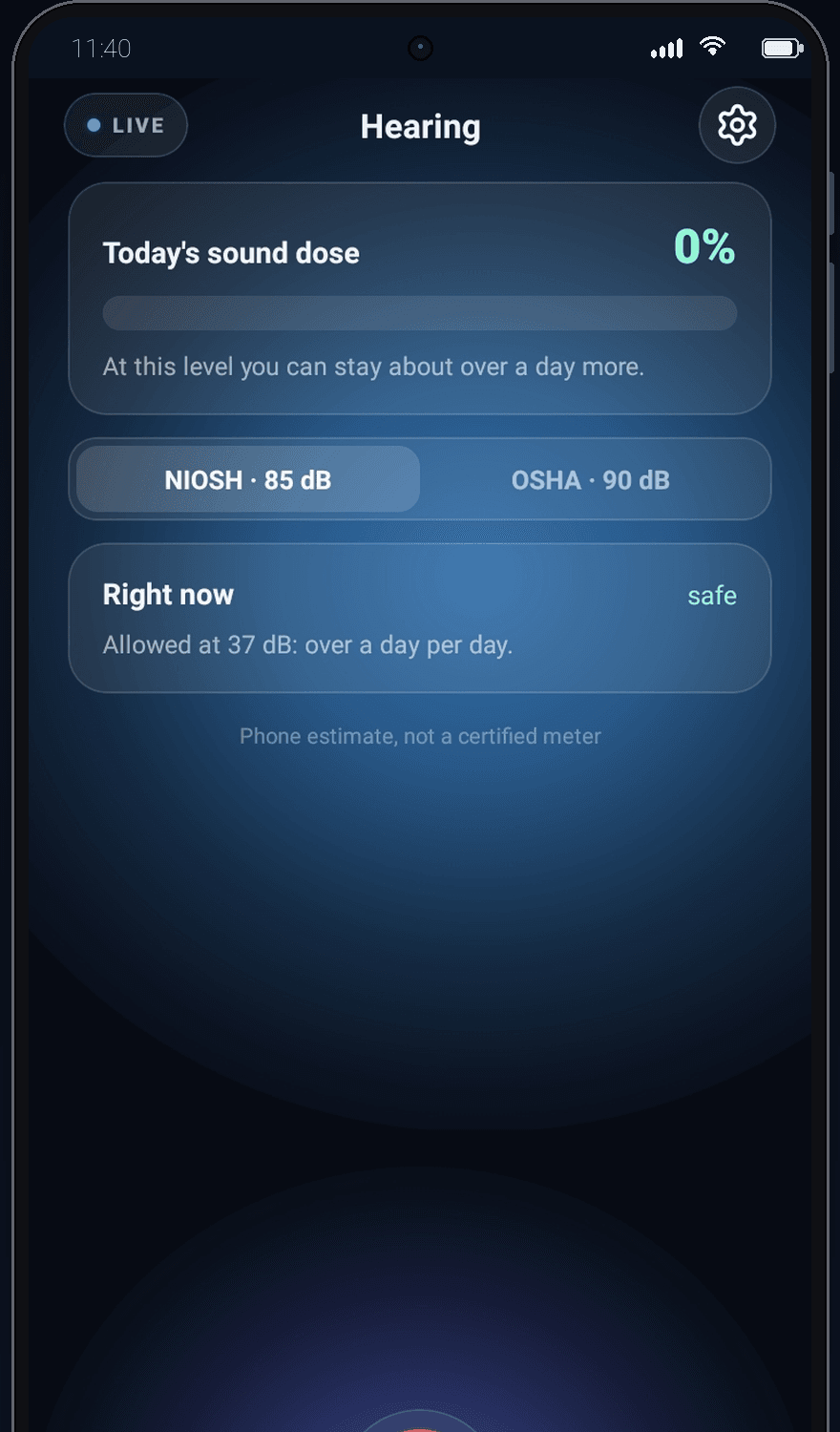
The Hearing tab tracks your daily sound dose against the two standards that matter: NIOSH at 85 dB and OSHA at 90 dB. It tells you how long you can safely stay, in hours and minutes, not formulas.
- Live safe-time countdown at the current level
- NIOSH and OSHA side by side
- Dose bar turns amber, then red, as you use up the day
Proof, timestamped
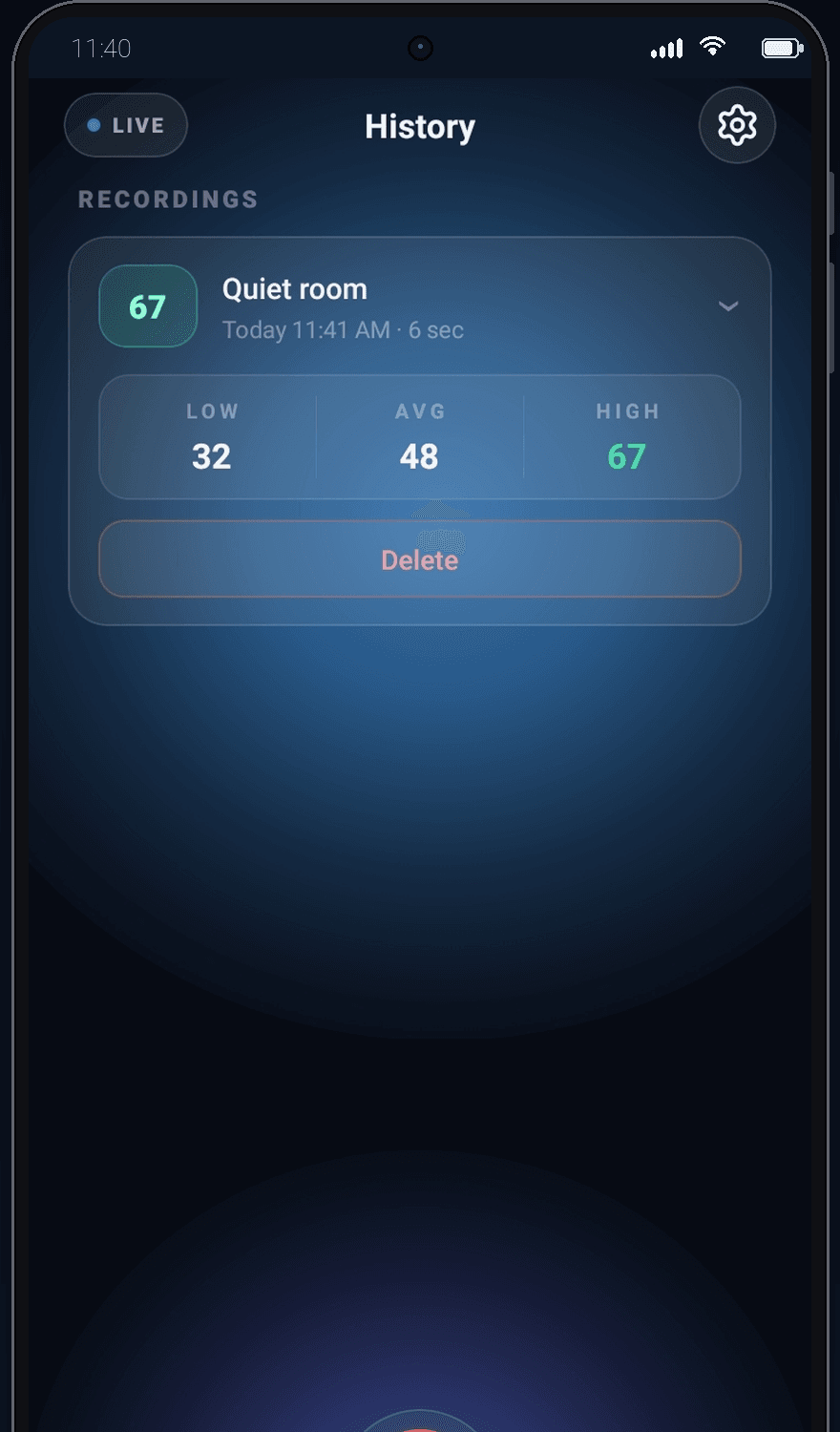
Record a session, give it a name, and Din keeps the low, average and high dB alongside the date and duration. Enough to show a landlord a pattern rather than an anecdote.
- Low / Avg / High kept for every recording
- Named sessions like “Upstairs, Tuesday night”
- Shareable sound reports and CSV export
Private by design
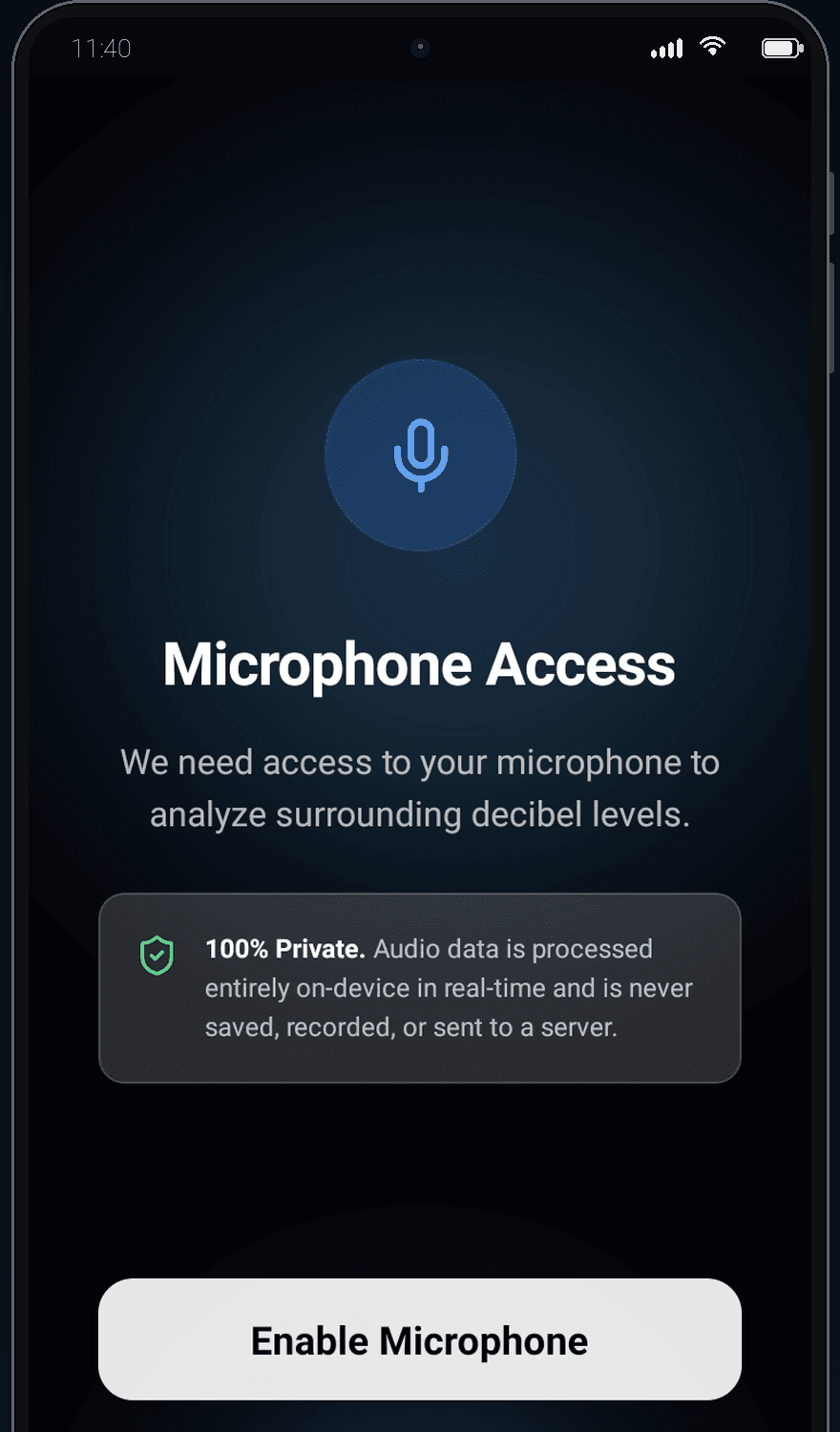
Every reading is computed on your phone, in the moment. Audio is never written to a file, never uploaded and never used to train anything. There is no account to make.
- Audio never leaves your phone
- No account, no sign-in, no tracking
- Microphone is the only permission asked for
How it works
Ready in seconds.
Three steps, and only the first one is required. Most people never go past it.
Open
The meter is live before you have finished unlocking the phone. No setup screen, no account, no calibration wizard. Just the reading and the colour that goes with it.
Record
One button starts a session. Din watches the level the whole time and keeps the low, average and high, so you end up with the shape of the noise rather than one lucky number.
Save & share
Name the session and it goes into History with its timestamp. From there you can send a readable sound report or export the data as CSV.
Decibel reference
How loud is 30, 50, 70, 85, 100 or 120 dB?
Decibels are logarithmic, so the numbers are not intuitive: 90 dB is not a little louder than 80 dB, it is twice as loud to the ear and uses your daily safe exposure roughly ten times faster. Here is what each step actually sounds like.
30dB
QuietHow loud is 30 dB?A quiet bedroom at night
30 dB is genuinely quiet: the level of a library reading room, or a bedroom with the window shut. You can hear your own breathing. Sleep researchers treat this range as the target for an undisturbed night.
Below the NIOSH 85 dB limit, with no daily exposure cap.
50dB
SafeHow loud is 50 dB?A calm home or quiet office
50 dB is the hum of a room that is being used but not working hard: a fridge in the next room, light rain, a quiet office before everyone arrives. Conversation is effortless at any distance.
Below the NIOSH 85 dB limit, with no daily exposure cap.
70dB
CautionHow loud is 70 dB?A busy street or a running vacuum
70 dB is where a room starts to feel loud. You raise your voice a little to be heard across a table. It carries no hearing risk on its own, but it is the point at which noise becomes tiring over a long day.
Below the NIOSH 85 dB limit, with no daily exposure cap.
85dB
DangerHow loud is 85 dB?The line where hearing risk starts
85 dB is the threshold NIOSH sets for an eight-hour day: heavy traffic from the kerb, a food blender, a busy factory floor. Past this point exposure time matters as much as the level itself.
Safe listening time at 85 dB: 8 hours per day (NIOSH).
100dB
DangerHow loud is 100 dB?A nightclub, a chainsaw, a motorbike
100 dB is loud enough that safe exposure is measured in minutes rather than hours. Shouting is required at arm's length. This is typical of a club dancefloor, a petrol chainsaw or a motorbike at close range.
Safe listening time at 100 dB: 15 minutes per day (NIOSH).
120dB
DangerHow loud is 120 dB?Front row at a concert, where pain is close
120 dB is near the threshold of physical discomfort: the front of a concert crowd, a siren beside you, a jet on the apron. Damage can begin almost immediately, and hearing protection is the only safe answer.
Safe listening time at 120 dB: 9 seconds per day (NIOSH).
Safe listening times follow the NIOSH recommended exposure limit: eight hours at 85 dB, halving for every additional 3 dB. OSHA's permissible limit is more permissive, allowing eight hours at 90 dB and halving every 5 dB, and Din can show either. Real-world levels vary with distance and reflections, so treat these as well-grounded reference points rather than exact thresholds.
Questions
The honest answers.
What Din is not
Din uses your phone's microphone, so readings are estimates. They are tuned for everyday accuracy, but they are not a replacement for a certified sound level meter in legal or industrial settings.
How accurate is Din?
Din reads your phone's microphone and is tuned to be dependable for everyday decisions: is this room loud, is this concert risky, is my flat quieter than the street. It is not a certified sound level meter. Phone microphones are built for voice, they compress very loud sounds, and they vary between handsets, so treat every reading as a good estimate rather than a legal measurement.
Can I calibrate it?
Yes. If you have access to a calibrated meter, you can apply an offset in Settings so Din matches it on your specific device. Most people never need to, because the default tuning is close enough for the questions the app is built to answer.
Is a phone reading good enough for a noise complaint?
It is good supporting evidence, not proof. A timestamped Din recording with low, average and high dB shows a pattern over time, which is often what a landlord or council asks for first. If the matter becomes legal or formal, an environmental health officer will take their own reading with certified equipment.
Does Din upload my audio?
No. Everything is analysed on-device in real time. Audio is never recorded to a file, never saved and never sent to a server. What Din stores is the decibel numbers for the sessions you choose to save. There is no account and no sign-in.
How does the daily sound dose work?
Dose combines how loud it is with how long you have been there. Din tracks it against two standards: NIOSH, which allows eight hours at 85 dB and halves the time for every extra 3 dB, and OSHA, which allows eight hours at 90 dB and halves for every extra 5 dB. At 100 dB, NIOSH allows about fifteen minutes a day. Reaching 100% means you have used your full allowance for the day.
What do the colours mean?
Colour is the reading. Blue is quiet, below 50 dB. Mint is safe, 50 to 70 dB. Amber is caution, 70 to 85 dB. Red is danger, 85 dB and above. Every colour is paired with words on screen, so you never have to rely on colour alone.
Which devices does Din run on?
Din is available for iPhone and for Android phones and tablets. It needs microphone permission to read the level, and nothing else: no location, no contacts, no network access for measurement.
Is Din really free?
Yes. Din is 100% free with no ads, no subscriptions, no paid tier and no account. Every feature described on this page is included.
How loud is it? Open Din and you'll know.
From 30 dB libraries to 120 dB concerts, on iPhone and Android.
- 100% free
- No ads
- No subscriptions
- No account